🥛
How to Make Tofu From Scratch: Soy Milk, Coagulants, and the Press
From a bag of dry organic soybeans to a block of tofu in an afternoon — the soy milk base, the three coagulants and what each does, firm vs. silken, what to do with the okara, and which firmness belongs in which dish.
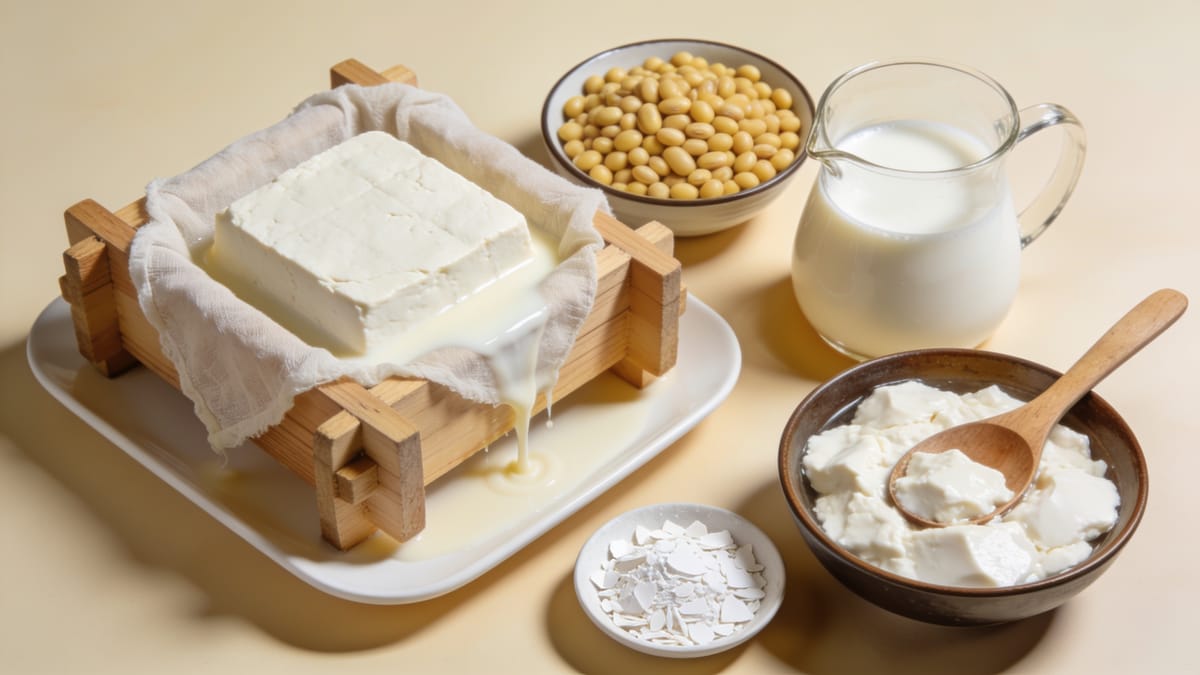
Tofu has been made the same way for roughly two thousand years: turn soybeans into milk, curdle the milk, press the curds. That's the whole trick — the same three moves as cheesemaking — and it works on a home stove in an afternoon. A bag of dry organic soybeans from the bulk aisle becomes fresher tofu than anything in a package, with nothing added but water and a coagulant, and it feeds directly into the 22 tofu dishes on our menu. (Making tofu without soy is its own art — that guide is here.)
Step 1 · Soy Milk (the base for everything)
Makes about 5 cups · overnight soak + 30 min
Ingredients (all organic)
- ✓Dry organic soybeans, 1 cup
- ✓Water, 4 cups for blending (plus soaking water)
Method
- Soak the beans in plenty of water 8–12 hours; they'll roughly triple. Drain and rinse.
- Blend with 4 cups fresh water until completely smooth, about 90 seconds.
- Strain through a nut-milk bag or tight-weave cloth, squeezing hard. The dry pulp left behind is okara — keep it (see below).
- Bring the raw milk to a boil in a tall pot — it foams aggressively, so stay close — then simmer 10 minutes, stirring the bottom. Raw soy milk must be fully cooked to be digestible.
- Skim any skin. This is soy milk: drink it, or carry on to tofu while it's hot.
Homemade soy milk is just beans and water — most cartons add gums, oil, and sweeteners. For drinking, a pinch of salt rounds it out. Keeps 4 days refrigerated.
Pick your coagulant
- Nigari (magnesium chloride) — the traditional Japanese choice. Clean, slightly mineral bite; firm, bouncy curd. Sold as flakes or liquid at health stores and online. Use about 2 tsp flakes dissolved in ½ cup warm water for the batch below.
- Gypsum (calcium sulfate) — the traditional Chinese choice. Softer, custardy curd, and it meaningfully raises the tofu's calcium. The best pick for silken. About 1½ tsp in ½ cup warm water.
- Lemon juice or apple cider vinegar — the pantry option. About 3 tbsp, stirred into ¼ cup water. Slightly tangier curd, a touch crumblier — completely fine for a first batch, no shopping required.
Step 2 · Block Tofu (firm to extra-firm)
Makes one 10–14 oz block · 45 min from hot soy milk
Ingredients (all organic)
- ✓Fresh soy milk, 5 cups, hot
- ✓One coagulant from the list above, dissolved
Method
- Bring the soy milk to about 170°F — steaming and just shy of a simmer — then take it off the heat.
- Add the dissolved coagulant in three additions, stirring gently once or twice after each, then stop stirring.
- Cover and rest 15 minutes. The milk separates into white curds floating in pale-yellow whey. If it's still milky, add a little more coagulant and rest 5 more.
- Ladle the curds into a cloth-lined tofu mold or small colander; fold the cloth over the top.
- Press under a flat weight (a plate with a pan of water works): 20 minutes for firm, 45–60 for extra-firm. Chill in fresh water.
Firmness is just press time and weight — you're choosing how much whey to leave in. Store under water, changed daily, up to 4 days — or freeze slabs; frozen-then-thawed tofu turns spongy and drinks marinades, which some of our dishes exploit on purpose.
Step 3 (optional) · Silken Tofu
Makes about 3 cups · set in the container, never pressed
Ingredients (all organic)
- ✓Rich soy milk: 1 cup dry beans blended with only 3 cups water, cooked as above
- ✓Gypsum, 1.5 tsp, dissolved in 2 tbsp warm water
Method
- Make a concentrated batch of soy milk — less water is what makes silken set like custard.
- Stir the gypsum slurry into the hot milk, pour immediately into bowls or a container, and cover.
- Leave completely undisturbed 25–30 minutes — no stirring, no peeking-and-jiggling. It sets in place like panna cotta.
- Chill. Spoon it straight, or slide it whole into a dish.
Silken is coagulated in its container and never pressed — that's the entire difference. This is the tofu our creamy applications call for; the block from Step 2 won't substitute, in either direction.
Don't throw out the okara
The pulp left from straining is okara — high-fiber, mildly sweet, and a legitimate ingredient in its own right in Japanese home cooking. Fold it into pancake or waffle batter, veggie-burger mix, or granola; or toast it dry in a skillet into a couscous-like crumble. One batch of tofu yields about two cups of it — that's free food, not waste.
Which firmness, which dish
- Extra-firm (long press): everything seared, crisped, glazed, or skewered — the majority of our 22 tofu dishes, from the blackened tofu plates to the crispy orange sesame.
- Firm (short press): scrambles and hashes — it crumbles just enough. The Lumberjack Plate scramble wants exactly this.
- Silken (no press): the custard jobs — 1 of our dishes use it, like the green shakshuka, which poaches spoonfuls of it where eggs would go.
The bigger picture
Worried about soy itself? The human evidence is reassuring — we walked through the studies in Is Soy Bad for You? And organic matters here for a specific reason: certified-organic soybeans prohibit GMO seed by law, which settles the most common soy objection before it starts — the full why-organic case is here. Beans from the bulk bins, an afternoon at the stove, and the protein anchor of 22 dishes is yours from scratch.
Keep reading
- 💪 Where Do Vegans Get Protein? A Complete Answer, With Receipts
- 🧂 Low Sodium Vegan Meals: Why We Cap Every Dish at 500mg
- 🍃 Sugar-Free Plant-Based Cooking: The Stevia Playbook
- 🫘 Is Soy Bad for You? The Tofu Question, Answered With Studies
- 🚿 How to Wash Pesticides Off Produce (And What Washing Can't Do)
- 🫙 Cook the Bulk Aisle: A Menu From the Bins at Dill Pickle Food Co-op
- 🏋️ Do You Need Meat for Protein? The Fallacy, the Trial, and the Strongman
- 🧈 Make Your Own Soy-Free Tofu: Chickpea, Red Lentil, Pumpkin Seed & Hemp
- 🥡 High-Protein Vegan Meal Prep: A Week Above 25g Per Meal