🏋️
Do You Need Meat for Protein? The Fallacy, the Trial, and the Strongman
The belief that real protein only comes from meat, tested against the evidence: a head-to-head trial where vegans matched meat-eaters gram for gram in muscle gain, a Guinness world record set on plants, what the largest dietetics body on Earth concluded — and the honest caveats.
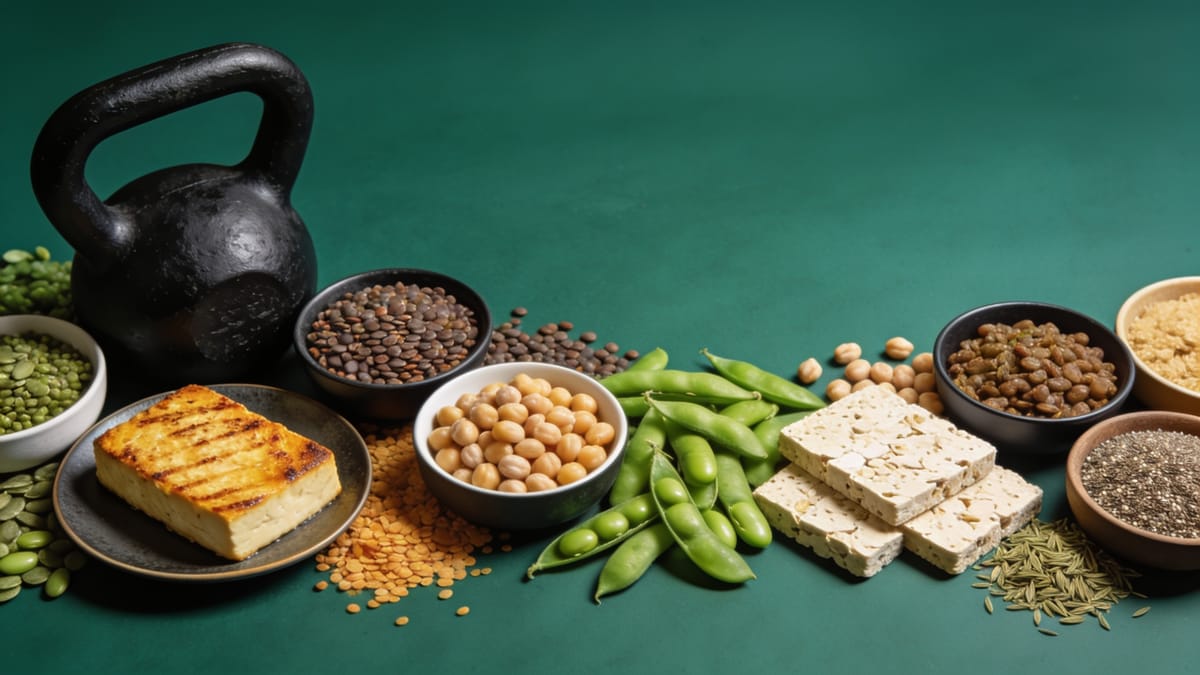
Ask a room full of meat-eaters where protein comes from and you'll get one answer: meat. It's the single most common objection to plant-based eating — so common we put the rebuttal on every plate we publish (20g average across 125 dishes, 27 of them at 25g or more, every gram itemized). But the belief itself deserves a proper autopsy: where it came from, what the clinical evidence actually shows, and who has already settled it with a barbell.
Where the fallacy came from
The idea that plant protein is second-class traces largely to the notion of “incomplete proteins” — popularized in the 1970s alongside the advice that vegetarians must carefully “combine” foods at every meal to build a complete protein. The author most associated with protein combining, Frances Moore Lappé, walked the advice back herself in the revised edition of Diet for a Small Planet a decade later. The biochemistry is plain: every whole plant food contains all nine essential amino acids — the differences are in proportions, not presence — and a normal day's variety of foods covers the amino acid pattern without any meal-by-meal arithmetic (Young & Pellett, American Journal of Clinical Nutrition, 1994).
The head-to-head trial
The cleanest test of the fallacy is simple: put vegans and meat-eaters through the same strength program with the same protein intake and measure who builds more muscle. That study exists. In a 12-week supervised resistance-training trial, 19 habitual vegans and 19 omnivores had their protein equalized at 1.6 g/kg/day (soy supplementing the vegans, whey the omnivores). The result: no difference in muscle mass or strength gains between the vegan and omnivorous groups (Hevia-Larraín et al., Sports Medicine, 2021). When the grams match, the muscle matches. The source of the protein didn't matter.
What the institutions concluded
- The Academy of Nutrition and Dietetics — the largest body of food and nutrition professionals in the world — holds that appropriately planned vegetarian and vegan diets are “healthful, nutritionally adequate” and “appropriate for all stages of the life cycle… and for athletes” (Melina, Craig & Levin, J Acad Nutr Diet, 2016).
- Do vegans actually hit their numbers in the wild? In the EPIC-Oxford cohort — one of the largest studies of vegetarians and vegans ever run — all four diet groups, vegans included, met recommended protein intakes on average, with vegans around 0.9–1.0 g/kg/day against a 0.8 g/kg recommendation (Sobiecki et al., Nutrition Research, 2016). The protein-deficient vegan is a hypothetical; the studies keep failing to find them.
Case studies: settled with a barbell
- Patrik Baboumian — vegan strongman — carried a 555.2 kg (1,224 lb) yoke for 10 meters at the 2013 Toronto Vegetarian Food Festival, a Guinness World Record he staged there deliberately, to prove strength doesn't require meat. He beat his own record two years later.
- Scott Jurek — vegan since 1999 — set the supported speed record on the full 2,189-mile Appalachian Trail in 2015: 46 days, 8 hours, 7 minutes — roughly 50 miles a day for a month and a half, fueled entirely on plants.
- Kendrick Farris — the only male weightlifter to represent the United States at the Rio 2016 Olympics — competed vegan, lifting a 357 kg combined total at his third Games.
None of this proves plants are magic — it proves the ceiling isn't where the fallacy says it is. If world records and Olympic totals can be built on plant protein, dinner can.
The honest caveats
- Digestibility: some plant proteins digest slightly less completely than animal proteins. The practical fix is unglamorous: eat a little more, and lean on the high scorers — soy and other legumes. (Our menu's protein anchors are exactly those: tofu, tempeh, lentils, chickpeas, seitan.)
- Older adults and hard-training athletes genuinely need more protein than the RDA — that's true on any diet. The trial above used 1.6 g/kg and the vegans kept pace; the target moves, the conclusion doesn't.
- B12 is the real supplement on a fully plant-based diet — it's a vitamin question, not a protein one, but it gets conflated into this argument. Take the B12; the protein takes care of itself.
- Worried specifically about soy? We wrote up what the human studies actually show — and the menu carries soy-free anchors too.
The receipts on our own menu
We built Rootful so nobody has to take this on faith: every dish prints its protein sources and gram counts right on the card. The current top of the board — Hot Maple Crispy Seitan (40g), Lemon Dijon Seitan (38g), The Lumberjack Plate (31g). Start with the complete protein-sources guide, or put it into practice with the 25g-per-meal prep plan — and if someone at your table still asks where the protein is, hand them a plate and the menu.
Keep reading
- 💪 Where Do Vegans Get Protein? A Complete Answer, With Receipts
- 🧂 Low Sodium Vegan Meals: Why We Cap Every Dish at 500mg
- 🍃 Sugar-Free Plant-Based Cooking: The Stevia Playbook
- 🫘 Is Soy Bad for You? The Tofu Question, Answered With Studies
- 🚿 How to Wash Pesticides Off Produce (And What Washing Can't Do)
- 🫙 Cook the Bulk Aisle: A Menu From the Bins at Dill Pickle Food Co-op
- 🥛 How to Make Tofu From Scratch: Soy Milk, Coagulants, and the Press
- 🧈 Make Your Own Soy-Free Tofu: Chickpea, Red Lentil, Pumpkin Seed & Hemp
- 🥡 High-Protein Vegan Meal Prep: A Week Above 25g Per Meal