🚿
How to Wash Pesticides Off Produce (And What Washing Can't Do)
The baking-soda method that outperformed bleach in peer-reviewed testing, the FDA's actual advice, the products not worth your money — and the honest limit: systemic pesticides absorbed into the flesh that no wash can reach.
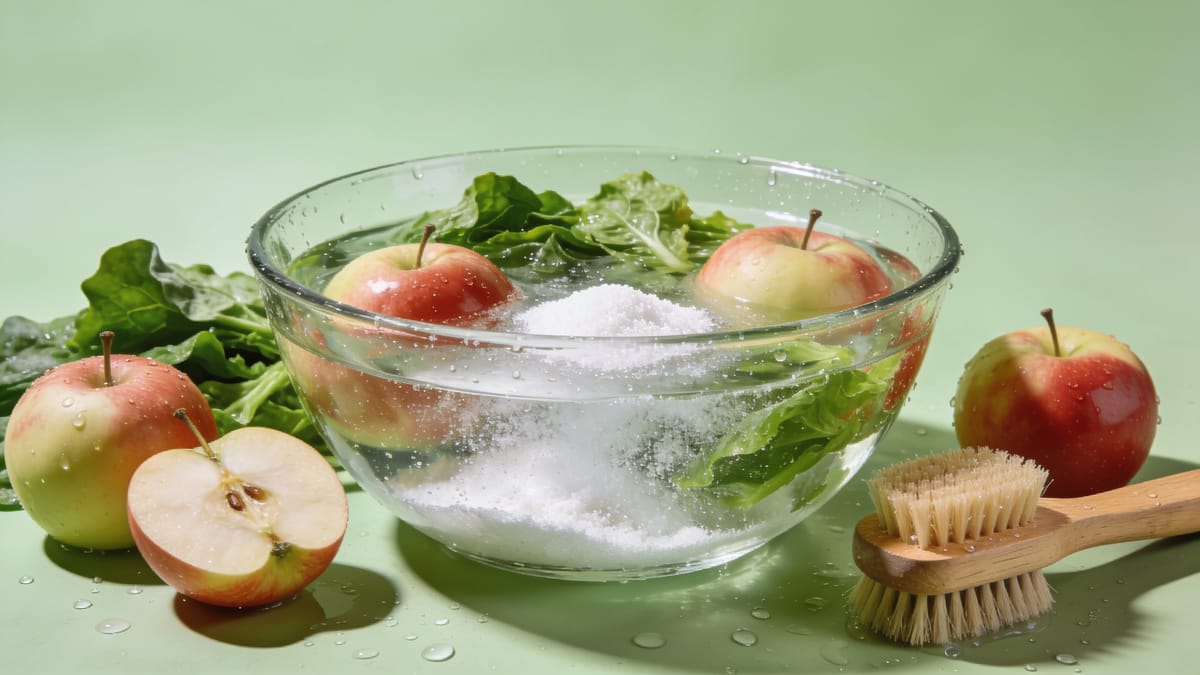
You've seen the numbers on our residue database — so the natural next question is: can't you just wash it off? The honest answer is partly. This guide covers the method with the best peer-reviewed evidence, the products that don't earn their price, and the hard limit that no washing technique can cross.
The method the science backs: a baking-soda soak
In a 2017 University of Massachusetts study published in the Journal of Agricultural and Food Chemistry, researchers compared tap water, a bleach solution, and a ~1% baking-soda (sodium bicarbonate) solution on apples treated with two common pesticides. The baking-soda soak won decisively: 80% of the fungicide thiabendazole and 96% of the insecticide phosmet removed after 12–15 minutes. The alkaline solution doesn't just lift residues — it actively degrades many pesticide compounds, which are unstable at high pH.
- Dissolve ~2 teaspoons of baking soda per quart of cold water in a large bowl.
- Soak the produce 12–15 minutes, giving it an occasional swish.
- Scrub firm items (apples, potatoes, cucumbers) with a soft produce brush during the soak.
- Rinse well under running water and dry — a salad spinner earns its drawer space here.
For delicate greens and berries, skip the scrub: a shorter soak (a few minutes), a gentle swish, and a thorough rinse right before eating — washed berries spoil faster, so wash at serving time, not storage time.
The quick version: running water still matters
No time for a soak? The FDA's own guidance is plain running water plus friction — rub with your hands or a brush for 20–30 seconds. It removes a meaningful share of surface residue along with dirt and microbes, and it's the right move even for organic produce and even for things you peel (the knife drags the peel's surface through the flesh otherwise).
What's not worth your money
- Commercial “produce wash” sprays and soaks. The FDA explicitly recommends against washing produce with soap, detergent, or commercial produce wash — they've never been consistently shown to beat plain water, and their own residues are untested. Baking soda costs pennies and has the better data.
- Ozone and ultrasonic “purifier” gadgets. Some lab evidence exists for ozone degrading certain surface pesticides, but the consumer devices sold on that premise are thinly tested and heavily marketed. We don't promote them — if the evidence matures, this page will change.
- Bleach, vinegar soaks, and salt water — bleach lost to baking soda in the UMass testing (and isn't food-safe advice); vinegar and salt help with microbes more than pesticides.
The honest produce-washing kit is four unglamorous items: a box of baking soda, a soft produce brush, a big bowl, and a salad spinner. That's the whole “device.”
The hard limit: systemic pesticides
Here's what no soak, scrub, gadget, or peeler can fix. Many modern pesticides are systemic — the plant absorbs them through roots and leaves and distributes them through its tissues, so the residue is in the flesh itself, not on the surface. The same UMass study proved the point: thiabendazole (a systemic) penetrated the apple peel four times deeper than the non-systemic phosmet, and the portion inside the apple could not be washed away by any method tested. Neonicotinoids — among the most common residues in USDA testing — are systemic by design.
A quick word on wording: these residues aren't technically “toxins” (that term belongs to biological poisons) — the accurate term is pesticide residues, and that's what you'll see across our residue database.
This is the whole reason Rootful is organic-only: washing is a good habit for the outside of your food; organic sourcing is the only lever for the inside. Wash everything — and start with produce that has less on it to begin with.
Sources
- Yang, T. et al. “Effectiveness of Commercial and Homemade Washing Agents in Removing Pesticide Residues on and in Apples.” J. Agric. Food Chem. 2017, 65(44)
- U.S. FDA, Selecting and Serving Produce Safely
- USDA Pesticide Data Program residue data — our searchable guide
Keep reading
- 💪 Where Do Vegans Get Protein? A Complete Answer, With Receipts
- 🧂 Low Sodium Vegan Meals: Why We Cap Every Dish at 500mg
- 🍃 Sugar-Free Plant-Based Cooking: The Stevia Playbook
- 🫘 Is Soy Bad for You? The Tofu Question, Answered With Studies
- 🫙 Cook the Bulk Aisle: A Menu From the Bins at Dill Pickle Food Co-op
- 🥡 High-Protein Vegan Meal Prep: A Week Above 25g Per Meal